


Alaska D-1 Withdrawals
When the Alaska Native Claims Settlement Act (ANCSA) passed in 1971, Section 17(d)(1) of the act directed the Secretary of the Interior to “review the public lands in Alaska and determine whether any portion of these lands should be withdrawn . . . to insure [sic] that the public interest in these lands is properly protected.” To implement this congressional direction, the Secretary then issued a series of public land orders (PLOs) from 1972 to 1973 that “withdrew” over 158 million acres of land in Alaska, which was essentially all of the BLM-managed lands in Alaska at the time. These withdrawals—which became known as “D-1 withdrawals”— withdrew the land from various uses, such as mining and mineral leasing, while the BLM completed inventories and assessed resources to help develop land management objectives. These withdrawals also protected land status until Alaska Native Corporations (ANCs) could make their original land entitlement selections under ANCSA.
The purposes for which these lands were originally withdrawn under ANCSA 17(d)(1) have been satisfied.
Timeline
Since ANCSA became law more than 50 years ago, these D-1 withdrawals have been thoroughly reviewed and addressed in a variety of ways. The Secretary has modified, revoked in part, and revoked in full some D-1 withdrawals to allow for different activities.
The timeline below summarizes major milestones in the history of D-1s.
1971-1973
Through ANCSA, Congress withdraws all unreserved public lands in Alaska for a period of 90 days. During this time, the Secretary reviews, and ultimately withdraws over 158 million acres of land under the authority provided by ANCSA Section 17(D)(1).
1980
Congress passes the Alaska National Interest Lands Conservation Act (ANILCA), setting aside over 100 million acres of public lands for inclusion in National Parks, Refuges, Conservation Areas, Recreation Areas, National Forest, and National Wild and Scenic River Systems. These new conservation system units include lands that had been previously withdrawn as D-1’s, and added to existing parks, refuges, forests, and wild and scenic river systems created by prior different withdrawals. ANILCA also includes provisions that call for the review of some D-1 lands for partial revocation, or to allow certain uses. Based on the BLM’s analysis, the Secretary issues PLOs on approximately 10 million acres statewide; the new PLOs have the effect of partially revoking (i.e. allowing for additional uses on the withdrawn lands) prior D-1withdrawals.
2004
Congress passes the Alaska Land Transfer Acceleration Act (ALTAA). Section 207 of ALTAA directs the Secretary of the Interior to review the D-1 withdrawals to determine if any portion of the withdrawn lands can be opened for other purposes under the public land laws. At this stage, the original more than 158 million acres of D-1 withdrawals remain in place, though some have already been modified, and some overlap the ANILCA-created conservation areas described above. Nearly 57 million acres of these D-1’s are on BLM-managed lands.
2006
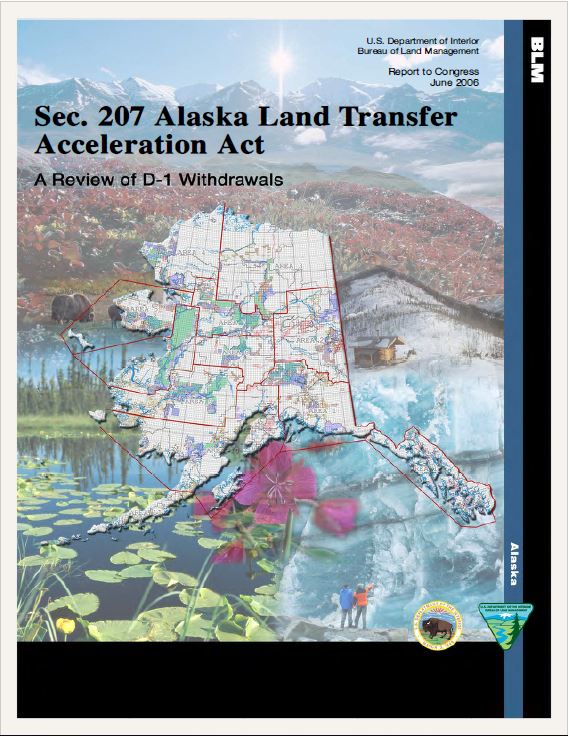
The BLM submits its ALTAA Section 207 report to Congress, recommending revocation of the D-1 withdrawals on approximately 50.1 million acres of BLM-managed land. In the report, the BLM recommends that its land use planning process be used to address review of these withdrawals.
2008 – 2021
The BLM develops resource management plans and records of decision for all BLM-managed lands in Alaska. Each resource management plan analyzes potential revocation of D-1 withdrawals as described in the BLM’s ALTAA Sec. 207 report, and most provide recommendations to the Secretary of the Interior to revoke the D-1 withdrawals.
2018
The Secretary of the Interior revokes D-1 withdrawals in Goodnews Bay area, and opens approximately 230,000 acres to normal BLM management under all public land and mining laws, as recommended by BLM in the Bay Resource Management Plan. This is the first area in the state where D-1 withdrawals are completely revoked. Since revocation occurred, these lands have been managed for multiple use by the BLM, and some of the land has been conveyed to the State. Though the history of these lands includes historic mining, there has not been any new uses permitted in the area since revocation occurred.
2019
The Secretary of the Interior revokes D-1 withdrawals in the Fortymile region of the Eastern Interior planning area and the Bering Glacier region of the East Alaska planning area, consistent with the recommendations made by the BLM in their respective resource management plans. These D-1 withdrawals had covered approximately 1.4 million acres. Since revocation occurred, these lands have been under normal BLM management under all public land and mining laws, and some of the land has been conveyed to Alaska Native Corporations under ANCSA. There has not been any significant industry development in the area.
2021-2022
In January 2021, the Secretary signs and publishes Public Land Order 7899, which would have revoked D-1 withdrawals within the Kobuk-Seward Peninsula planning area, consistent with the recommendations in the resource management plan. At the same time, the Secretary signs four public land orders (7900 – 7903), to revoke D-1 withdrawals within the Ring of Fire, Bay, Bering Sea – Western Interior, and East Alaska planning areas, consistent with the recommendations in their respective management plans; however, those public land orders are never published in the Federal Register. In total, those five public land orders would have revoked D-1 withdrawals on approximately 28 million acres across all five planning areas.
In April 2021, the Department of the Interior defers (i.e. takes action to pull it back from the Federal Register before the effective date) the opening order for Public Land Order 7899 (Kobuk-Seward Peninsula), and does not publish the four remaining public land orders, pending further review.
As an initial step in the review, the BLM completes an environmental assessment to open lands within the five planning areas to selection under the Alaska Native Vietnam-era Veterans Land Allotment Program (ANVLAP). This analysis results in new PLOs 7912 and 7929, which partially revoke D-1 withdrawals to open approximately 28 million acres specifically to selection by eligible applicants under the ANVLAP.
2022-2024
BLM analyzes the impacts of opening lands in the 2021 public land orders (7899, 7900, 7901, 7902, and 7903) in the ANCSA 17(d)(1) Withdrawals Final Environmental Impact Statement (EIS). The Secretary at the time signs a decision selecting the no action alternative, and publishes Public Land Order 7947, rescinding all five public land orders from 2021, thus keeping the approximately 28 million acres as continued “D-1 withdrawals.” Learn more about that decision and review supporting documents on the BLM National NEPA Register project webpage.
Separately, BLM publishes Public Land order 7952, opening over 11 million additional acres in the Central Yukon planning area for selection by qualified applicants under the Alaska Native Vietnam-era Veterans Land Allotment Program.
2025-Present (Current)
In January 2025, Executive Order 14153—”Unleashing Alaska’s Extraordinary Resource Potential”—directs the Department to evaluate changes to D-1 withdrawals, including to Public Land Order 5150 and to open the lands evaluated in the 2024 EIS.
In February 2026, BLM published Public Land Order 7966, revoking PLOs 5150 and 5180, and opening 2.1 million acres of lands within the Dalton Utility Corridor north of the Yukon River.
The BLM is currently undertaking a process, which includes consultation with local tribes and entities. If DOI fulfills the direction provided in Executive Order 14153, these 28 million acres – like all of BLM’s multiple use lands generally – would be available for the full range of uses under BLM’s multiple use mandate under the public land and mining laws.
POINT OF CONTACT
Brittany Templeton
Realty Specialist
(907) 271-4214
[email protected]
Sec. 207 of the Alaska Land Transfer Acceleration Act
Or, view a copy of the report at these BLM offices: