Helium

The Helium Program, administered by the U.S. Department of the Interior and the Bureau of Land Management, ensures that the Federal Government receives proper payment for helium extracted from federal mineral acreage.

What’s New:

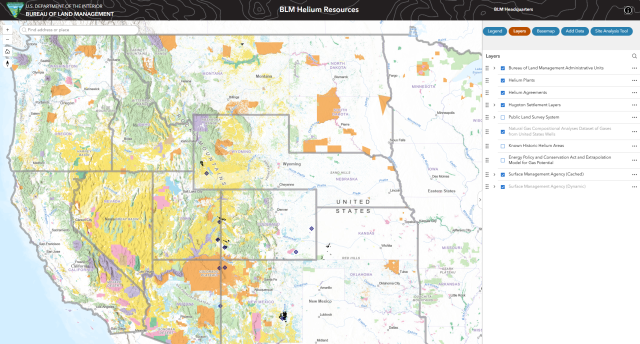
The BLM has developed a new interactive Helium Web Map that is intended to help promote helium development and production on public lands by highlighting the location of helium concentrations, including if it occurs alongside helium processing plants. 

This map uses publicly available national datasets of natural gas geochemistry, including helium. The dataset is maintained by the U.S. Geological Survey and reports the measured values of helium in molar percent, which helps operators gauge helium concentration. 

This dataset contains information from 1920 to 2005 and is from 21,000 well gas sample analyses. In addition, concentrations of various other gases are provided, if available, including hydrogen, nitrogen, hydrogen sulfide, argon, oxygen, methane, and others. 

It also includes a layer depicting helium gas processing plants, and other infrastructure published in the U.S. Geological Survey’s 2023 Helium Minerals Yearbook, which provides standardized, reliable information on where helium and helium infrastructure is located. The Helium Web Map includes clickable layers for users to display Federal Helium Agreements, Hugoton Settlement Agreements, Public Land Survey System, Historic Helium Concentration Areas, and Federal oil and gas leases.

Helium is an odorless, nontoxic, colorless, tasteless gas; it has a very low chemical reactivity and it is lighter than air. These characteristics are why helium plays a prominent role in space exploration, national defense, scientific research, medical technology, high-tech manufacturing and energy programs. Helium exists as a gas except under extreme conditions. At temperatures near absolute zero, helium is a liquid.
Space Shuttle Atlantis Being Launched
Interactive Helium Web Map that highlights the location of Helium, alongside other helium infrastructure.
Screen shot of BLM Helium web map tool with land status, helium plants, and helium development areas indicated with layers panel open.
The Helium Resources Program negotiates and administers helium royalty contracts; researches, adjudicates, collects, and audits monies for helium extracted from Federal lands; analyzes natural gas samples to locate and evaluate sources of helium.
helium plant
The Helium Stewardship Act of 2013 (HSA) seeks to mitigate a helium shortage by enabling the Secretary of the Interior, acting through the Director of the BLM to continue to sell crude helium from the Federal Helium Reserve.
A sign reads "U.S. Department of the Interior, Bureau of Land Management, Cliffside Gas Field and Crude Helium Enrichment Unit, Managed by: Amarillo Field Office and Cliffside Refiners Limited Partnership." Behind the sign is an industrial facility with pipes, equipment, and storage containers under a clear blue sky.